Showing posts with label books and children. Show all posts

Tuesday, 3 September 2019

The apparent simplicity of language: the text and its shadow


I am a reader.

An avid reader of children's books and an avid reader of books about children's books. This means I often get myself bogged down with particular details about writing that is aimed at children and what exactly makes it "literature for children" and not "literature for adults" or just "literature".

One of the things I like to do in order to find some answers, is explore the boundary around what we call "children's literature". At first this seems obvious (and a waste of time), but once one begins looking more carefully, varied and less-firm territory appears.(For example, if "children's literature" is a body of literature read by children, then what about Harry Potter, who has a large adult fan base too? Or Winnie The Pooh with its sophisticated double address that amuses children and elicits knowing smiles from adults?)

Perry Nodelman is a widely respected critic and academic in the field of children's literature and in his book The Hidden Adult: Defining Children's Literature he traces these boundaries. One of the points he discusses is children's books and their apparent simplicity of language. On the whole it is accepted that children's books should be written with a slightly less sophisticated reader in mind, a reader who does not yet possess the skills and the vocabulary to fight their way through long, complex, Proustian sentences. Let alone have the attention span. (This may be true, but it doesn't have to mean "talking down" to the reader.) Anyway, this rule is not set in stone (no one told Charles Dickens this when he was writing Oliver Twist) and sometimes is deliberately broken (think of Lemony Snicket's informative, context-specific asides to the reader about what difficult words mean in A Series of Unfortunate Events).

However, I would have to agree with Nodelman, that children's books imbue words with a kind of magic that makes them communicate far beyond their immediate meaning. This is what Nodelman refers to as the "shadow text". The writing is simple, yet the shadow text is not. Nodelman states, "The simple text implies an unspoken and much more complex repertoire that amounts to a second, hidden text." Here lies the magic of children's literature.

Of course one can argue that adult texts also have this shadow text, but the disjunction is clearer in children's books because we accept and expect their simplicity of language. The existence of this shadow therefore means that the simplicity of the story actually requires the reader to have more knowledge than the story actually contains. We, the reader (adult and child), must tap into our repertoire of past experiences, knowledge and understandings of the world in order to read the shadow text.


As a result, when we read David Walliams' first line from The Boy in the Dress: "Dennis was different", our repertoire of playground and classroom memories allows us to fully comprehend the story behind that experience. The prose is simple and straight-forward, but the story is not.


Similarly, Eva Ibbotson's first line from Journey to the River Sea, "It was a good school, one of the best in London" doesn't bog the reader down with long-winded and elaborate descriptions of the school and its standing. That introductory line tells us everything we need to know not because of the  text, but the shadow behind it: Maia's privilege and also her limitations.

Good children's books maintain the simplicity of language, but have carefully selected words that have the ability to throw magical shadows.


Friday, 21 July 2017

Can we talk about Enid Blyton?


A picnic with my two lovely girls at the Botanical Gardens got me thinking about Enid Blyton. We packed some snacks, a blanket and some books, one of them an Enid Blyton classic, The Secret Seven. The kid (who is now seven) has become enchanted by the Faraway Tree and The Secret Seven. If I read her a chapter, she will soldier on determinedly on her own, eating up the story word by word, a finger marking the steady progress. I never thought that watching a fledgling reader could make me feel so happy, but it does.

Which brings me to Enid Blyton.

The Wishing Chair, The Faraway Tree, The Famous Five, The Secret Seven and all those page-turning adventure stories made up my reading childhood. I discovered the heady addiction of stories, the desperate need to find out what happens next even after lights out, through these books. I was eight when I started to read in English, having just moved to South Africa with my parents. Enid Blyton books quickly became part of my reading diet and continued to be favourites for years. Reading them felt a bit like making friends in a new place. A lot of it didn't make sense to me or reflect my new life in South Africa. I still have no idea what sort of meal "tea" is. Green meadows and lanes, and the cold, misty, rainy weather all took on mythical qualities in my mind. The humidity and heat, the lush, out-of-control coastal vegetation with its troupes of vervet monkeys, the street vendors at the intersections, the rickshaw drivers at the beachfront, the intoxicating multiculturalism were all absent in the stories I picked up. But it didn't matter. I loved reading them anyway.

Much criticism has been leveled at Blyton for her culturally insensitive, gender-stereotypical stories, but for all that she did wrong, she certainly did something right. Children, pretty much everywhere, love her stories. And this raises a very important question, one I often engage with, namely, who determines what "good" children's literature is? Good according to whom? Who decides? Children or adults? Are adult critics even qualified to do this?

The lack of working mothers, touches of racism and xenophobia, the obvious classism are sometimes hard to overlook as an adult now rereading some of my childhood favourites, but then I watch my fledgling reader's growing hunger for them and suddenly I don't feel so qualified to tell her what she can and can't read.

I think Chimamanda Ngozi Adichie's Ted Talk The danger of the single story is particularly relevant to children's literature. Perhaps the solution to the Enid Blyton problem is not to eliminate her from children's reading diets, because she certainly has earned her place there, but rather to feed them a rich variety of stories from different places and backgrounds. In other words, offer them a balanced diet with a healthy sprinkling of magic.

So, what are your views on Enid Blyton?


Saturday, 17 September 2016

Just one more word


The nightly bedtime story ritual at the moment goes something like this:

Me: "Okay, that's the end of the chapter. We'll have to wait until tomorrow to find out what happens."
The kid: "Ohhhh, don't, don't, no, no!"
Me: "No really, it's the end. You agreed just one chapter, remember?"
The kid: "Noooo! PLEASE just one more story. PLEASE!" (Looks hurt, as if I'm an abusive parent.)
Me: "No, we agreed we would finish at the end of the chapter." (Feels like an abusive parent)
The kid (distraught, on the verge of tears): "PLEASE Mama, just one more WORD!"
Me: "A word is very short. It won't help."
The kid: "Please!"
Me: "Okay." (reads one more word)
The kid (wailing): "Noooo!"
Me: "That was one word."
The kid (looks greatly hurt and disappointed): "Fine! I just won't give you any more goodnight kisses then!"

Tuesday, 5 April 2016

What do children want to read?


Children and stories and reading go together. I like seeing a pile of books next to the kid's bed, or finding her asleep, her hand still resting on a current favourite, or tripping over them on the carpet, or seeing them piled on the coffee table.

But sadly this seems to be the exception. Children don't read anymore or, at best, don't read enough. We hear this repeated throughout the various loops of educational circles. The remedy it seems, is more regimented reading programmes and carefully manufactured books. However, Jack Zipes, expert on the fairy tale and critic of Disney, argues that our response to this decline in reading among children and young people is based on "misreading" the situation. This misreading has resulted in the state, its education departments and the publishing industry ushering in an array of reading programmes and an unhealthy quantity of books without substance.

His is an interesting argument that challenges the response to the reading crisis and one that cautions us about the direction these interventions have taken. In particular he takes to task national reading surveys (for example the National Endowment for the Arts in the USA which looks at the decline in reading for pleasure) for not discussing the quality of books that are being manufactured for young people. He points out that we are simply looking at a skeleton of numbers.

I'm particularly interested in the questions Zipes asks, those questions that the skeleton remains mute on: "What is a book for children? How are children exposed to reading materials and taught to use them? What are the diverse socio-cultural contexts in which children read? Do other media complement the reading of books? Hasn't the screen replaced the book to produce multimodal reading? Why read what we read, and do we have a choice? What role does social class, race, and gender play in learning how to read?" (2009:31).

So what should children be reading? I've written about my disappointment with what is on offer in most toy stores in South Africa before, with the narrowing of literature to easy-to-sell products. When it comes to access to books the range is incredibly limited, which doesn't do much for answering the question of what children should be reading.

Zipes takes Disney to task for making the book a product that is pushed onto children. The Disney approach moves seamlessly from movie to book to toy to CD. Disney artifacts are everywhere and the stories are lost somewhere among them. Tinkerbell is appropriated and repackaged and lost to J.M. Barrie. Cinderella and Belle and Snow White are transformed into two dimensional shadows of their former selves and children loose touch with the roots of those old stories.

Zipes states, "One might argue that the example of Disney is not typical of the book publishing industry for children. But that is not true. The impetus to produce books that will replicate themselves, books to produce films that replicate the books, films to produce books to replicate the films, books that will sell books of the same category - this impetus can be found throughout the industry. As far as the publishers are concerned, books are to be manufactured to sell other books, and in the process, the tastes and values of children are to be molded to suit the tastes and values of the culture industry en large, for a book is no longer a single commodity but closely connected if not intertwined with other similar products. If children are to read, they are basically encouraged to consume more and more of the same."

I'm a bit torn on this one. Part of me says read... just read... anything that takes your fancy... it's okay to just wander. Another part wants to direct, to map, to plan out the journey of the reader. More of the same might be comfortingly familiar, particularly to the developing reader, but in order to grow we have to try new things... pick up that unfamiliar story not associated to a familiar TV character or the well-worn spin-off from a movie.

That is where the problem lies and Zipes' argument is that the book as commodity can't solve our reading crisis, that in fact, if anything, it deepens it. 

Monday, 19 October 2015

Dear Monday: on the border of day and night, we become their novelist


I feel like the day has crumpled up around me, lost its structure like a tent with its poles removed. A softly collapsed mess devoid of its former shape. Me still stuck somewhere in it.

I think I may have underestimated the demands of two little ones and working motherhood. Certainly of managing two sets of needs: there are after school swimming lessons AND nappies, lunchboxes AND bottles to prepare, soothing and rocking AND bedtime stories. The end of the day does seem to collapse in on itself at times, the automatic routine of feeding and bathing and unpacking and repacking and washing and sorting and playing and fixing and listening, gaining the sort of momentum that eventually undoes itself.

And then just as suddenly, the frenzy is over, and it's bedtime. The little one popped into her cot with her bottle first, then the bigger one tucked into bed, snuggled up close for a story. The day seems to somehow regain its structure. I can recognise myself again. A full stop at the end of the sentence. All makes sense once more.

There's never a night without story time, no matter where we are, no matter how tiring the day was or how late it is. There's a magic in it that can't be skipped. It made me think of a section in Daniel Pennac's charming The Rights of the Reader. I thought I'd share his reflections on parents and that magical reading that takes place on the border of day and night, here:

We were in a state of grace during those early years. Our total sense of wonder in the face of a new life transformed us into geniuses. For them, we became storytellers. As soon as they emerged, blinking, into the world of language, we told them stories. It was a talent we didn't know we had. Their enjoyment inspired us. Their happiness gave us voice. We created character after character, adventure after adventure, ratcheting up the plots. We invented a whole world for them, much as the aging Tolkien did for his grandchildren. On the border of day and night, we became their novelist.
Not that it would have mattered if we'd had no talent for storytelling. If we'd told them other people's stories - badly, groping for words, mispronouncing names, mixing up adventures, muddling the beginning of one with the ending of another... Even if we hadn't made up stories at all, if we'd just read aloud, we'd still have been their personal novelists, their special storytellers helping them slip into their dreamy pajamas every evening before dissolving under the sheets of night. More than that, we were the book.
Remember that intimacy. There's nothing like it.
How we loved scaring just for the thrill of consoling! And how desperately they wanted to be scared! They weren't fooled, even then, but they trembled all the same. They were real readers, in other words. What a playful partnership we formed: they the cunning readers, we the book!

So beautiful!


(recent travel pictures: Slovakia)

Saturday, 17 January 2015

The language of books


The other day, the kid and I ended up "writing" a book together. I say "ended up" because it didn't start out as the intention of our activity. At first she simply wanted to draw a picture of Cinderella living in a castle in the jungle. Intrigued by this exotic setting, I offered to write that on the picture for her and so, with a few prompts and questions from me, she started telling a thrilling story about Cinderella's encounter with a lion in the jungle. She drew the pictures (with some assistance from me) and I took down what she told me.

I was particularly fascinated by her use of language and narrative structures she would normally not have uttered during everyday conversation. For example, adverbial phrases like "one morning, Cinderella..." (this occurred twice in her story), her use of rising tension "Cinderella was in the jungle alone and then she saw a shadow and it was a roaring sound" (before revealing that it was a lion) and of course, finishing off the story with the traditional "and then they got married and lived happily ever after". I had to marvel at where this language had appeared from because she'd really mastered certain key elements of narration here.

This got me thinking about the language of books and how narratives are absorbed into us from so young. It also got me thinking about how written and spoken language are not the same. On the surface this seems an obvious statement, but it is in fact more complex than it appears (in fact, lots of adults don't understand that you can't write like you speak). Children soon realise that books and the stories they tell have a language all of their own; we don't speak like books do and this is something that the kid appears to have begun grasping in our little story-experiment. This highlights how language output relates to language input: the more books that are read to them, the more children begin to internalise the syntax and semantics of language and can produce them in creative versions of their own.

In Proust and the Squid: The story and science of the reading brain, Maryanne Wolf makes a strong argument for what reading offers children in terms of cognitive development. While oral stories contribute immensely to children's language development which will of course positively impact their reading abilities later on, it is through the written word that their cognitive and linguistic capabilities are enriched. Wolf writes:
"Phrases like 'once, long ago' and words like 'elfin' aren't part of typical discourse. However, they are an integral part of the language of books and give children clues that help them predict what type a story is and what might happen. Indeed, by kindergarten, words from books will be one of the major sources of the 10 000-word repertoire of many an average five-year-old."
This is particularly well illustrated by a study Wolf refers to. In this study, two groups of five-year-old children were looked at. All were of a similar socio-economic background and had parents of equal educational attainment (factors that are known to influence literacy), however, the one group had been "well read to" (at least five times a week) and the other had not. The study simply required these children to do two things, firstly to tell a story about a personal event and secondly, to pretend they were reading to a doll.
Wolf notes, that "the differences were unmistakable. When the children in the 'well-read to' group told their own stories, they used not only more of the special 'literary' language of books than the other children but also more sophisticated syntactic forms, longer phrases, and relative clauses. What makes this significant is that when children are able to use a variety of semantic and syntactic forms in their own language, they are also better able to understand the oral and written language of others. This linguistic and cognitive ability provides a unique foundation for many comprehension skills a few years later, when children begin to read stories of their own."
Stories are so much fun, yet so powerful! Just one more reason to keep on reading...


Thursday, 27 November 2014

The book with a hole


Books are so fantastically diverse; that's what's so great about them! Some books stretch the boundaries of what a book should be to the point where its pages transform into a toy, a prop, a prompt, a springboard into our imagination...

One such book is The book with a hole by Herve Tullet. It is exactly that, a book with a hole right through the middle, but instead of there being something missing, it provides a host of endless possibilities with which to weave our own stories and scenarios. Tullet's black and white illustrations are simple and allow the reader to be as inventive as they like; one minute the hole can be a statue, a scene of what's on a TV set, a face, a plate of food, a scary crocodile that's just waiting to snap off someone's fingers. Questions prompt the reader to begin imagining an answer and so the stories begin...

It's a fantastic book to share with children and the kid and I had some fun with it and her little baby sister the other day. This book is sure to result in an afternoon of giggles and silliness!

"Did she eat too much too?"

"Who lives here?"

Monday, 17 November 2014

The reading divide


Lately I've been reading Maryanne Wolf's Proust and the Squid: The story and science of the reading brain and she begins by touching on a big socio-cultural divide between those children who were read to before the age of five and those who were not. She calls it a "little-discussed class system" and refers to a study that found a gap of 32 million words between children from print-rich homes and print-poor homes in children of kindergarten age. She's very right of course, it does create a type of class divide which plays itself out in academic achievement and ultimately future opportunities.

I know that this is an international problem, but in a South African context, the divide is even more stark. We have the double problem of homes where parents (or often grannies who are the primary caregivers) are functionally illiterate and, perhaps more problematic, a population that places little emphasis on the written word; South Africa really lacks a culture of reading. The The South African Book Development Council (2012) estimates that only 1% of South Africans are regular buyers of books and only 14% can be considered "committed" readers (of a literacy rate of 88.7%). 

I strongly believe that this reading gap in the early years perpetuates an already very divided education system. The sad reality is that by the time that a child from a print-poor background enters school (through the now compulsory kindergarten year) it is already too late. They are already at a disadvantage. As Wolf writes: 
"Children who begin kindergarten having heard and used thousands of words, whose meanings are already understood, classified, and stored away in their young brains, have the advantage on the playing field of education. Children who never have a story read to them, who never hear words that rhyme, who never imagine fighting with dragons or marrying a prince, have the odds overwhelmingly against them."
 I think part of the problem is that for many, reading is associated with school and learning, and not necessarily fun which adds to a self-perpetuating and downward spiraling cycle of reading. The result is two-fold: firstly because reading isn't viewed as pleasurable, it becomes a chore (for example homework for older kids in the family) and watching TV is what families do to relax. Secondly, while the importance of reading may be acknowledged, it is often seen as belonging in the domain of schools and teachers, which means that for many children their first real interactions with books begin in school. Besides being too late, so many South African schools do not have a functional, let alone inviting, library that will inspire a love of reading.

And so the reading divide continues...


Old work photos I took of various rural and township schools and their libraries in KwaZulu-Natal


Monday, 20 October 2014

Blurring the boundaries of "screen time"


I seem to have a bit of a soft spot for children's picture books that make a commentary on reading and interaction in the internet age (I wrote about Lane Smith's It's a book here). The newest one to come into my hands is Dot by Randi Zuckerberg and illustrated by Joe Berger. With cheerful illustrations and playful language it tells the story of a little girl called Dot, who "knows a lot". She's an ace with all different types of "screens":


Eventually Dot gets that familiar feeling of screen-time overload. She goes all cross-eyed and disorientated, so that her mom sends her to play outside.


Once outside in the sun, she remembers that she also knows how...


in the real world. The book is charming in it's reminder to leave the virtual world behind sometimes and give ourselves the opportunity to interact and play in the real one.

Having just said that, I have to admit to spending quite a bit of time reading articles via twitter on my phone (very handy with a hungry baby to feed and only one hand free). A New York Times article I recently came across asks the very pertinent question of whether E-Reading to your toddler counts as story time or screen time. The question is of course very relevant as more and more children's books are turned into interactive E-books for tablets, and parents are faced with endless choices of toddler and even baby entertainment for different screens.

According to the article, even the experts aren't sure. What is certain, is that pediatricians and child-development experts advise parents to read to their children regularly from an early age. They also advise no screen time for children under the age of two and less than two hours a day for older children. Where, then, does e-reading fall?

There doesn't seem to be much research out there yet, but the New York Times article points out that a handful of new studies suggest "reading to a child from an electronic device undercuts the dynamic that drives language development". It refers to a 2013 study, Once Upon A Time: Parent-child Dialogue and Storybook Reading in the Electronic Era, which found that 3-5 year olds whose parents read to them using a tablet had lower comprehension rates of the story than those children who were read to using a traditional book. Part of the problem, the researchers explain, was that parents and children using tablets spent more time focusing on the device than on the story. As the stories become more and more interactive in an E-format (which obviously does comes with educational advantages), the focus shifts away from the parent-child dialogue that springs up from the more old-fashioned forms of story time. Researchers have stressed that it is this early conversation around stories that assists language development. The New York Times article quotes Dr Hirsh-Pasek, who sums it up well, "In other words, it's being talked with, not being talked at that teaches children language."

So I guess, Dot does know a lot; we need to strike a healthy balance between the virtual world and the real one.

Wednesday, 3 September 2014

Story time


I fall into story time with you like into a cushy dream. My tiredness cuts off the world so that all that exists is the bed, you cuddled up to me and the pages of a book. Quietly you listen, every now and again your little body shifts, but your attention is fully absorbed in those shared pages between us. We reach the end and I put out the light but I'm too tired to leave, to go wake from the dreamy state of story time. Instead, I lie there in the darkness and we whisper special messages into each other's ears. Your voice so present, as you lean over to me to whisper your thoughts, your hair tickling my face, the stories lingering softly on your breath. And momentarily the whole world disappears into your softly spoken little words.


Monday, 30 June 2014

The question of babies and where they come from


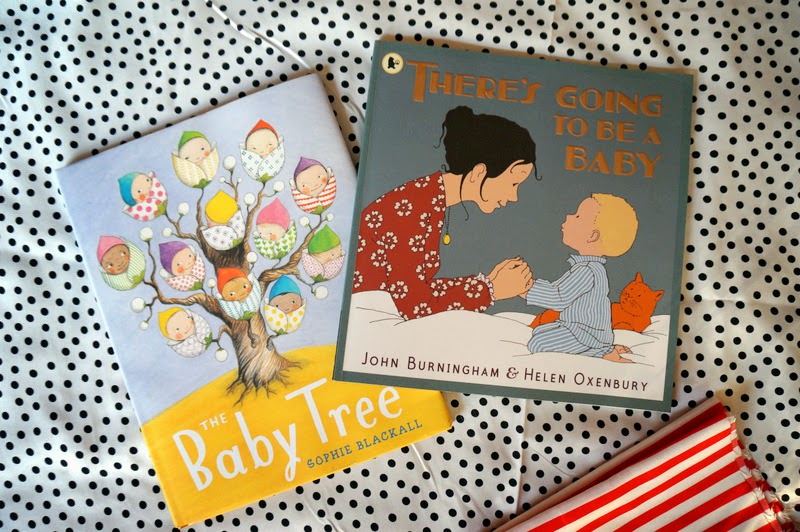
I've always turned to books for answers; searching for meaning between the covers of a book is a kind of well-established, lifelong habit. So, when I've had to answer the kid's questions about the news that she's getting a little sister or brother, I've turned to the following two beautifully illustrated books: There's going to be a baby by John Burningham and Helen Oxenbury and The Baby Tree by Sophie Blackall. With the kid cuddled up on my lap, we've paged through these two new favourites and talked about all kinds of things related to the "baby in Mama's tummy".

There's going to be a baby is a sensitive and beautifully illustrated story about a little boy finding out he's getting a brother or sister and the different moods and responses he has to this news.


The illustrations capture the changing seasons leading up to the birth and explore both the time he spends with his mother as well as his internal world imagining this new baby. It's both funny and very true.


What I love about Sophie Blackall's new book, The Baby Tree, is her commitment to honesty and answering children's questions with just the right balance of openness and understanding. The story follows a curious little boy whose very busy parents tell him the news that a new baby is coming.


Once he has absorbed this information, of course many questions arise, such as where do babies come from? He then sets out to question the people in his life about this and gets a whole lot of confusing answers. Olive, his teenage baby sitter, tells him babies come from the seeds that grow into a baby tree.


His teacher, Mrs McClure, says that babies come from the hospital.


Grandpa tells him about how the stork brings babies and leaves them on the doorstep.


Roberto, the mailman, thinks that babies come from eggs. So eventually he ends up asking his parents who give a beautifully honest answer that ties in elements of each of the other responses and finally he feels satisfied about this baby mystery.


There's so much more delight to share from these two books, so I would highly recommend them!


Wednesday, 28 May 2014

Old classics redesigned


Who doesn't love childhood favourites such as Mary Poppins, Little Red Riding Hood, Rapunzel and all those others? Aren't they beautifully represented in these minimalist, but incredibly effective posters by designer Christian Jackson? I keep encountering them during my travels around the internet and each time I seem to fall in love with them more! Time to get some maybe...?


Friday, 2 May 2014

The book that I fell in love with (and got me hooked)


In Jay Heale's delightful (and distinctly South African) book, Hooked on Books: Why and what to read to your child, she talks about the need for babies and children to handle a book in order for them to really fall in love with them:
"A child needs to be physically connected with the book as an object. You know how small children examine an object. They look at it, stroke it, sniff it, chew at it sometimes. A book is a 'thing' just as much as a spoon or a blanket or a favourite teddy bear."
That's just the first step to truly getting "hooked on books" . Children need to really internalise or own what a book offers. It has to reach deep into them and provide that "food for fantasy" as German children's author, Otfried Preussler famously stated. Jay Heale goes on to say that owning what a book offers goes, "beyond buying books for children, though that can be part of the process. I mean the process of letting what is inside the book transfer itself to you. That includes the sight of the pictures, the sound of the words, the chance to let your mind wander off, to imagine the new ideas, new people, new places, the laughter and the amazement."

If I think back to my childhood, one book stands out as being such a book, namely Die Abenteuer des starken Wanjas (The adventures of strong Vanya) by Otfried Preussler. I remember sitting enthralled on the carpet while our Grade 2 teacher read to us. Although mostly text and simple black and white line drawings, I remember this book as as infinitely colourful and was completely carried along on Wanja's adventures as overcame various challenges to become Tsar in the land beyond the White Mountains.


I was completely captured by this story and when I left Switzerland my Grade 2 teacher gave me a copy of this book to take with me. To be able to keep that story, its magic contained between the covers, was an incredibly empowering experience for me. I could carry that magic with me, hold it, touch it and through this process I fell in love with the book as object.

Although I may not have touched that book for years, I was always aware of it somehow; conscious of its presence there on the bookshelf. It filled a certain space in my mind. It was a kind of step.

Recently I pulled it out and reread it. Memories swirled up, rich and thick like sand in water. It was every bit as magical as the first time. This book really shaped me and I am forever grateful that it found its way into my hands.

Linkwithin

Related Posts Plugin for WordPress, Blogger...